

The Sheriff’s Dissertation, the Eight Records, and the Question Nobody Wants to Answer
A simple way to think about a complicated mess.

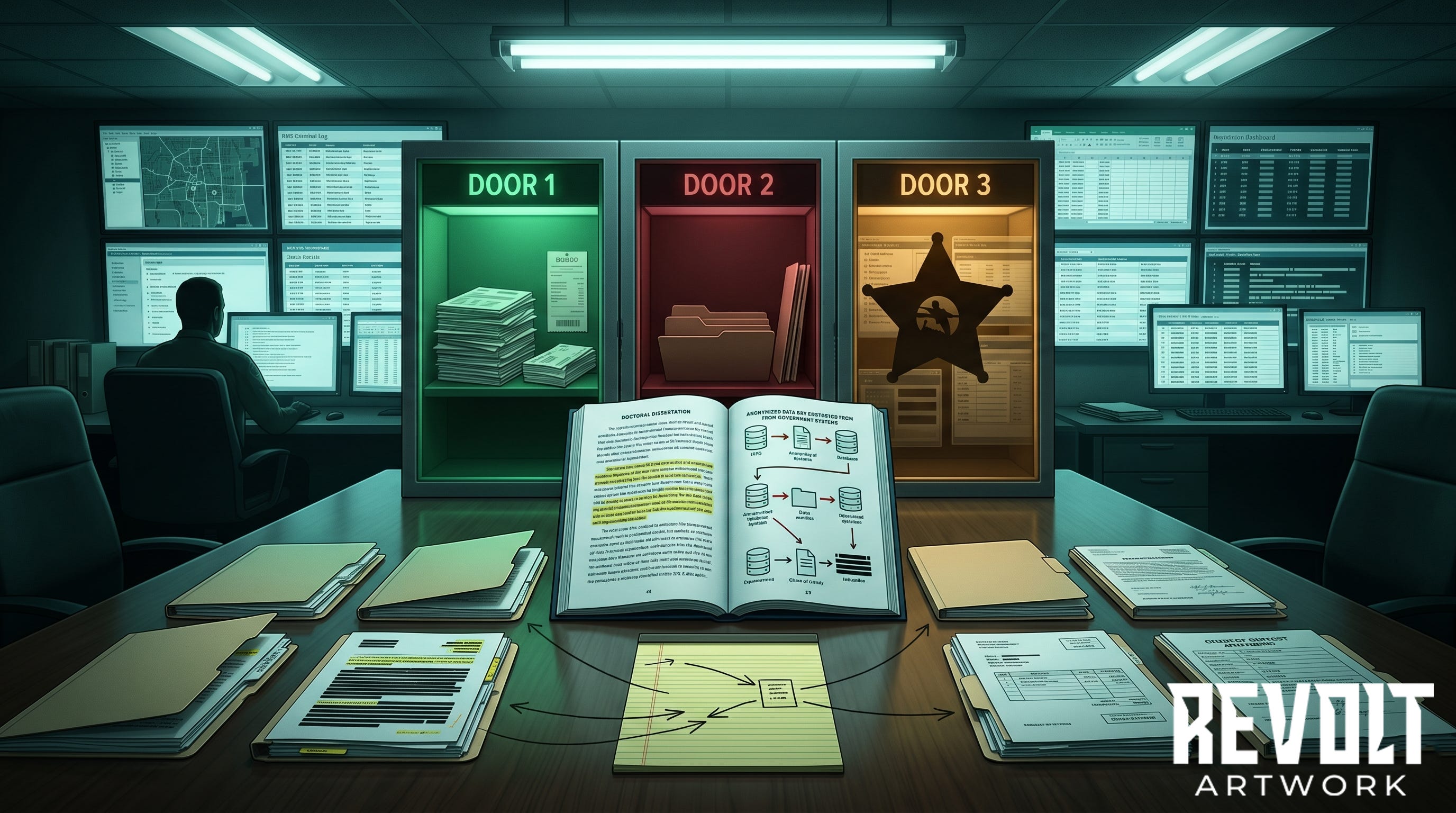
Sheriff Gregory Tony got a doctorate from Nova Southeastern University in 2024.
His dissertation includes a sentence on page 38. It says all the data he used was collected from BSO “in accordance with Florida public records laws.”
Two pages later, on page 40, the dissertation says how the data actually got to him. A BSO employee, or three, with security clearance(s) logged into four BSO computer systems. Pulled seven years of data. Stripped out the names. Handed it to the Sheriff.
That’s the story. Now here’s why it matters.
What is a public records request?
In Florida, anyone can ask the government for documents. You fill out a request. The government finds the records. You usually pay a fee. They give you copies.
This is called a public records request. The rules are in a law called Chapter 119.
When somebody files a public records request, the government has to keep paperwork showing what happened. There’s a log. There’s an invoice. There’s a receipt for payment. There’s a memo about anything they blacked out. There’s a letter saying the records were handed over.
If the Sheriff filed a public records request like he says, then eight pieces of paperwork should exist at BSO right now.
I asked to see them.
[ GET A COPY OF THE PLAYBOOK ]
Why send the request to the General Counsel?
The General Counsel is the lawyer for BSO. His name is Terrence Lynch.
I sent the request to him because he’s the agency’s chief legal officer and the records I’m asking about involve a sworn statement by his boss in a public document. The records custodian routes a stock denial. The General Counsel does not.
It’s his doctorate, not BSO’s doctorate.
And let’s be precise about what kind of doctorate. Tony earned an Ed.D., a Doctor of Education, from NSU. Not a Ph.D. The two letters change the academic register but not the question. Either way, the dissertation is his personal credential, not the agency’s research output. The page-38 sentence about Florida public records laws is in his dissertation. It’s signed by him. It’s bound, indexed, and shelved at NSU under his name.
Now here’s where it gets interesting
BSO has three ways to answer. Each one tells us something.
Door 1: The records exist. Great. The Sheriff filed a request, paid a fee, got the data, wrote a dissertation. End of story. We move on.
Door 2: The records don’t exist. That means no public records request was ever filed. Which means page 38 of the dissertation is wrong. Tony’s sworn academic statement to NSU is not supported by his own agency’s files.
Door 3: BSO says, “He didn’t need to file a request because he’s the Sheriff and the records belong to him.” This is the smartest defense and the one BSO will probably try.
Door 3 is where most people stop reading. Don’t stop. This is where it gets good.
The “I’m the Sheriff” defense
Tony will say: “I didn’t file a public records request because I am the custodian. I had the right to look at my own agency’s data.”
Fine. He had the right to look at the data as Sheriff. Nobody disputes that.
But he didn’t write the dissertation as Sheriff. He wrote it as a doctoral student at NSU. The dissertation is a personal academic credential. It’s his Ed.D., not BSO’s Ed.D.
So the question is not whether he could look at the data.
The question is: did he use BSO’s people, BSO’s computers, and BSO’s time to do his personal homework?
A patrol deputy at BSO who’s working on a master’s degree doesn’t get a sworn analyst to spend a hundred hours pulling 35,000 records out of four systems for his thesis. A sergeant doesn’t get that. A captain doesn’t get that. A lieutenant doesn’t get that.
Did the Sheriff get that?
If yes, that’s a problem.
The actual law that matters
There’s a Florida law called § 112.313(6). It says a public officer can’t use his official position or agency resources to get a special benefit for himself.
A doctorate is a benefit. A doctorate opens doors, raises pay grade ceilings, and provides a credential the holder keeps for life.
If BSO staff pulled the data and anonymized it and handed it to Tony so he could finish his degree, and no other BSO employee gets that kind of help, then the Sheriff got a special benefit. That’s the law’s whole concern.
Dr. Brocato just earned her Ed.D. Interestingly, BSO Insta indicates she earned her Ph.D. Brocato deserves, and rightly so, attaboys for her hard work and devotion to the community.
That said, the Insta post raises two questions:
Why does the government refer to her Ed.D. degree as a Ph.D.? Call me jaded, but really, come on now…
Did Brocato get a sworn officer to help do her homework?
Sorry, I digress, back to the matter(s) at hand.
Why the eight records matter
Each of the eight records I asked to see answers part of the question. Not all of it. Part of it.
The intake log would show whether a public records request was actually filed.
The fee invoice would show what was charged.
The payment record would show what was paid.
The fee waiver, if there was one, would show who in the agency authorized free service for the Sheriff.
The redaction memo would show why the data was anonymized and under what authority.
The production letter would show the date the records were handed over.
The authorization between Tony and the records custodian would show who at BSO approved the work.
The retention index would show whether any of this was filed and tracked the way every other public records request is tracked.
If most of those records exist, the Sheriff’s story holds up.
If most of those records don’t exist, the Sheriff’s story has a problem and the agency has a different problem, which is that the public paid for his homework.
What the records can prove and what they can’t
I want to be careful here. The records won’t prove Tony did anything corrupt. Sure Tony killed someone, sure Tony dropped some LSD, sure Tony drove around with a bad license, but in this case, the records will only prove what happened on paper.
But the absence of records is also evidence. When a government agency does something the right way, it leaves paperwork. When it does something the wrong way, the paperwork is what’s missing.
The eight records will tell us which version of the story is true.
What happens next
Three things, in order.
First, BSO has to answer the records request. The law gives them a reasonable amount of time. The clock started running when the request landed in the General Counsel’s inbox.
Second, I will compare the answer to the dissertation. The dissertation is a sworn academic document. It says certain things happened in a certain way. The records will either support the dissertation or contradict it.
Third, depending on the answer, I will either move on or file the next document. The next document is a complaint to the Florida Commission on Ethics under § 112.313(6). I’m not filing that yet. The records request comes first. The records request is the foundation.
The point of all this
Most people who file public records requests do it wrong. They ask for the data. They get hit with a $137,400 fee or a denial letter, and they walk away.
A good records request asks for the paperwork that proves something happened, not the data itself. The paperwork is small. The paperwork is cheap. The paperwork is what the agency has to keep whether they want to or not.
The eight records I asked for cost the agency almost nothing to retrieve and almost nothing to inspect. There’s no good way to refuse them. There’s no good way to overcharge for them. There’s only a way to answer them.
The agency has to pick a door.
Behind every door is a different story.
You will get data. Non-data is data. Use that data to your advantage.
The government gave you an answer. Stop, drop, and think.
Or call me.
Chaz Stevens is a First Amendment practitioner and constitutional stress tester based in Deerfield Beach, Florida. His work has produced legislative rewrites, policy reversals, and one governor who had to put his own name on the reason he changed his own law. He is the founder of REVOLT Training.
One More Thing
I’ve been doing this work for thirty years. Pro se lawsuits. Records requests. Bible challenges in 63 school districts. An FDUTPA injunction against an ESA letter mill, obtained without a lawyer. Statutes rewritten because I filed the wrong kind of paperwork the right way.
None of it has ever had an institution behind it.
No legal defense fund. No nonprofit board. No foundation grant. I fund the work myself. Filing fees, service, transcripts, records costs—it all lands on me. When a records custodian quotes $1,326.08 to produce documents the statute requires them to produce, that’s a bill I either pay or the work stops.
I’ve filed against Donald Trump, the Broward County School Board, State Representative Chip LaMarca, and ESA letter mills as indigent. Court-recognized. Sworn financials. Judges reviewed and approved every time.
This is the work. It produces results.
HB 1467 was rewritten, with the administration of Ron DeSantis naming me in the revision. The ESA injunction is a replicable enforcement model. The Wisconsin State Capitol approved a permit in 48 hours for an installation that normally takes ten business days to process.
The work works.
The math doesn’t.
I’m looking for paid work in three areas—defined by outcomes, not categories.
Accountability & Records
I identify exposure points in agencies and organizations using public records, then force resolution—through compliance pressure, media, or litigation.
Media & Narrative Engineering
I design stories that land. Not pitches that get ignored—events and documentation that reporters have to cover.
Technology & Infrastructure (Ecomm, GEO/SEO, Systems)
I’ve spent thirty years building systems that move money and control visibility.
Helped launch Disney.com and Blockbuster.com
Sold 60,000 vehicles through eBay—full pipeline, not theory
Worked inside NASA, IBM, and Microsoft
What I do now:
Build e-commerce systems that convert, not just attract traffic
Implement GEO/SEO so AI and search engines represent you accurately—and defensibly
Diagnose and fix structural issues in digital infrastructure that suppress performance
If your organization has traffic but no conversion, visibility but no control, or systems that “work” but don’t scale—I fix that.
If you run a nonprofit, newsroom, law firm, municipality, university, or company that needs any of this, contact me.
chazstevens@gmail.com
954-901-0971
If you don’t, forward this. One introduction changes the month.
If neither applies, the Consent Can funds the work. Women In Distress gets a cut.
I’ve spent thirty years making it expensive for corrupt people to stay corrupt.
I intend to keep doing that—and get paid for it.