

Schrödinger’s Sheriff
How BSO’s general counsel handed me the documentary record by trying to dodge a music license

Welcome to The Stevens Method. I’m Chaz Stevens.
If this issue was useful, send it to someone who’d use it.
Like it above if you got something from it.
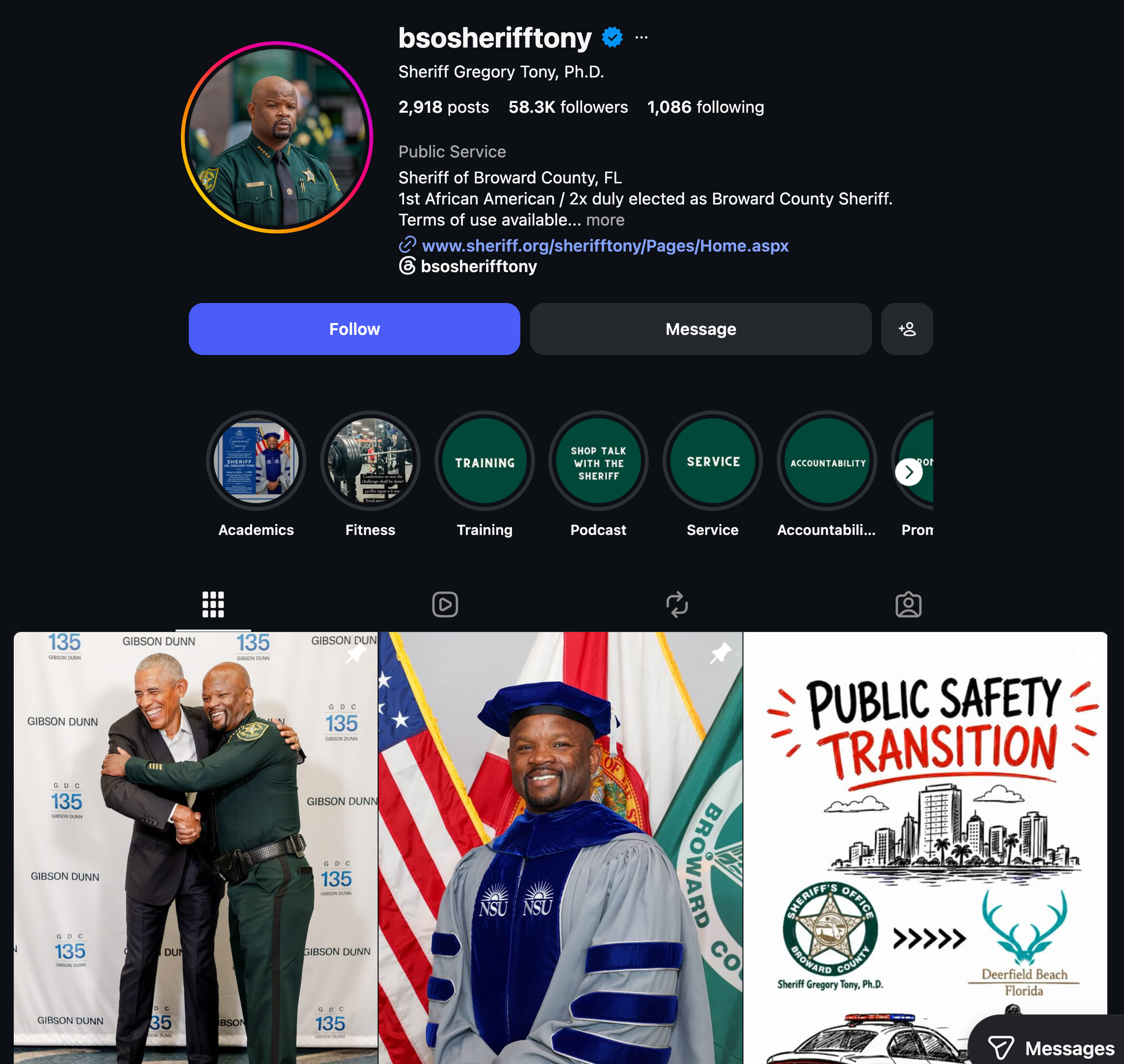
The account is verified. Blue checkmark. Category: Public Service, applied by Meta. Bio: “Sheriff Gregory Tony, Ph.D. Sheriff of Broward County, FL.” The bio link goes to sheriff.org. Sheriff.org’s footer lists the Instagram handle in the same row as BSO’s Facebook, Twitter, YouTube, and Snapchat. Sheriff.org’s Initiatives page is authored in Tony’s institutional voice and links to “important facts regarding BSO’s contract services with the City of Deerfield Beach.”
On April 27, 2026, the account posted to Instagram Stories. Audio: “Kung Fu Fighting,” Carl Douglas, 1974. Master sound recording. Mainstream commercial track.
I filed a Chapter 119 request for the synchronization license.
Records produced an Envato Elements stock-music license for a track called “Sports” by user SugarTape, purchased the same day as the request. The audio in the video is not the SugarTape track. The audio is Carl Douglas, performing his own song, on the recording the major labels have owned the master for fifty-one years.
I sent a five-day notice that the production was defective.
Twelve days later, BSO General Counsel Terrence M. Lynch, Esq. wrote back. Tony did not license Kung Fu Fighting from the publishers. Tony did not license it from Sony or Warner or whoever owns it this week. Tony used Instagram’s “public use library,” Meta’s consumer-side music catalog, and “properly attributed its use to the artist in accordance with Instagram’s terms of use for audio content from their library.”
The general counsel of a Florida constitutional officer just put in writing, on letterhead, that the Sheriff’s Instagram account qualifies for the consumer-side library.

Visit REVOLT.Training to learn more.
The consumer-side library is the one Meta makes available to accounts categorized as personal. The library Meta does not make available to accounts categorized as business, brand, government, or institutional. Meta runs a separate Commercial Music Library for those accounts. Different catalog. Different licenses. The split exists because the music industry sued Meta to make it exist.
Position of the account as of Lynch’s letter:
BSO publishes the handle as a BSO institutional channel on the agency’s own .org.
Meta categorizes the account “Public Service.”
BSO’s general counsel says, in writing, that the account uses the consumer library reserved for accounts that are none of those things.
Institutional when BSO wants reach. Personal when BSO wants the cheap music. Whatever the next legal problem demands.
Lindke v. Freed
601 U.S. 187 (2024). Two prongs. Both required.
One. Did the official have actual authority, rooted in statute, ordinance, charter, or custom, to speak for the government on the subject of the post.
Two. Did the official purport to exercise that authority in the post being analyzed.
Prong one, for a Florida sheriff on agency-jurisdictional subjects, is the easiest box in the doctrine. Constitutional officer under Article VIII, Section 1(d). Chapter 30, Florida Statutes. The Sheriff speaks for the agency on agency business.
Prong two is the fight. Any particular post.
A music selection is not, by itself, an exercise of governmental authority. I do not sue over song choice. That is not the play.
The play is the license posture. The agency, through counsel, characterized the account in writing in a way that contradicts how the agency publishes the account on its .org and how Meta categorizes the account in its UI. The contradiction is admissible.

Visit REVOLT.Training to learn more.
Posture
I am not suing BSO. I live in Broward County. My tax dollars run that agency. Suing my own county over a song clip is not a use of time, money, or process.
This is a pen test.
I work the margins on purpose. I send the records request. I read the response the way a lawyer reads a deposition transcript. For what the institution decided to say, in writing, when pressed.
High friction
My investigative process is intentionally high friction. When a bad actor penetration tests your systems, they do not bring tea and crumpets. They are there to break things. High friction, adversarial, call it whatever you want. I do not sand the edges. The edges find the faults.
The cracks exist. You do not see them yet. I will find them, they are there.
When the bad actors arrive, you will have wished you called first.
The institution decided to say “personal account, consumer library, properly attributed.” On letterhead. To a Chapter 119 requestor. In response to a notice letter that named the song, the artist, the date, and the account.
That is the record. The audit did not generate it. The institution generated it in response to my friction.
May 2026, Deerfield Beach
Deerfield is standing up its own municipal police department and fire-rescue. The boys and girls running those new departments are coming from somewhere. A lot of them will come from the agency that just put a written classification contradiction on letterhead over a piece of disco.
If Lynch can put that contradiction on paper, the lieutenants and captains and PIOs and social media coordinators of the new Deerfield departments will too. Not because they are sloppy. Because they trained somewhere the contradiction was normal.
Deerfield gets one chance. The departments do not exist yet. The accounts have not been created. The disclaimers have not been written. The blocked-user lists have not started. The moderation policies have not been adopted, contradicted, ignored, or weaponized.
This is the moment to put the policy in writing. Before the new chief’s personal account starts answering constituent-service requests. Before a PIO runs command-staff posts off a phone. Before fire-rescue Facebook becomes where residents file complaints, the complaints disappear, and the §1983 invoice arrives.
What LeX flagged
The methodology I have been building is called LeX. It scores posts on a 0-to-100 scale of post-Lindke exposure. Not a court ruling. A triage tool. Every score is reviewed by outside counsel before anything labeled “state action” leaves the building.
@bsosherifftony scored in the red band. The pinned “DEERFIELD BEACH RESIDENTS: URGENT PUBLIC SAFETY MESSAGE” graphic, with BSO and municipal insignia stacked together, sat near the top. The “DEERFIELD BEACH: DO YOU KNOW THE TRUTH” comparison graphic, also stamped with BSO insignia, sat in the same band. Other officials’ accounts I have run through LeX sit almost entirely in the bottom band. Tony’s is the inverse.
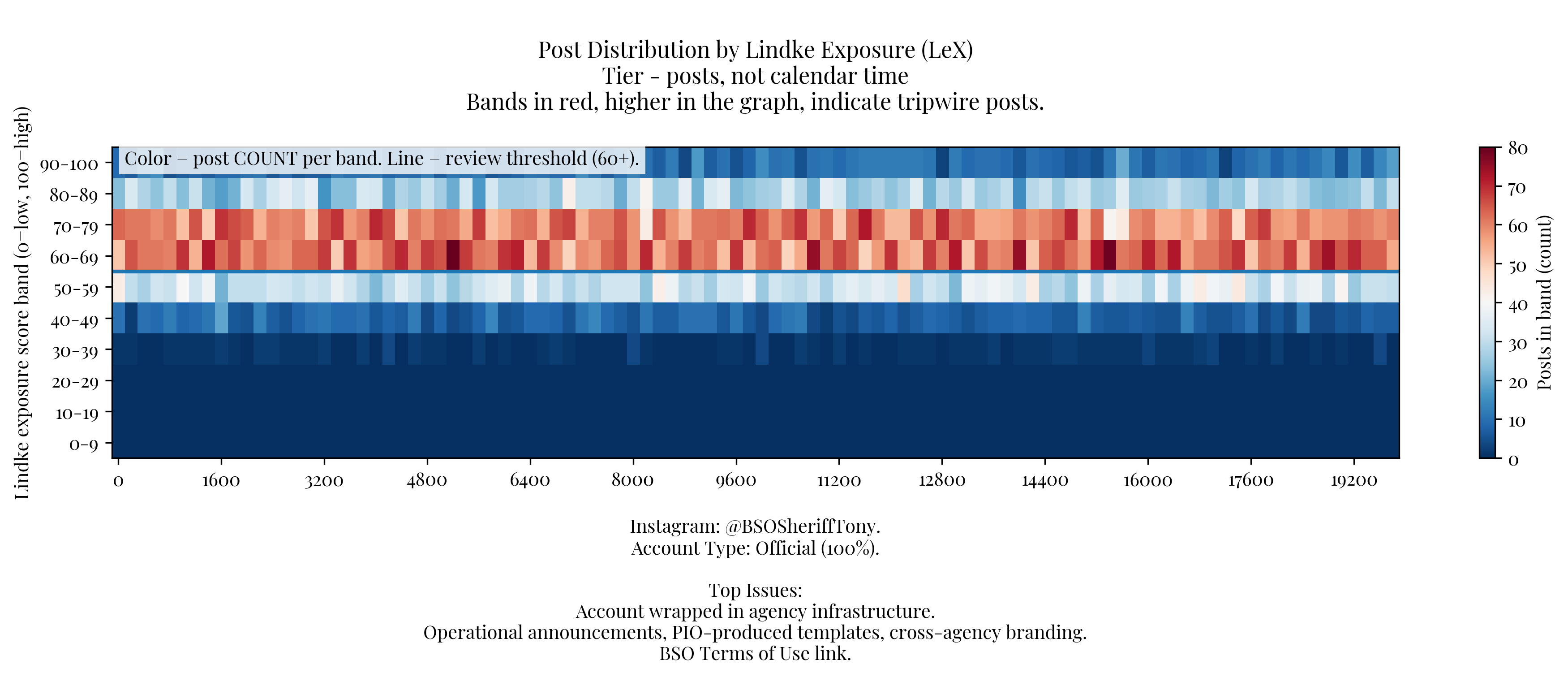
I am not handing the score to a court. I am not handing it to a plaintiff. The methodology goes to municipal lawyers, in working sessions, in CLE, in pre-litigation audits. So they find the same contradictions inside their own cities before someone else does.
What’s for sale
A one-hour working session. Doctrine, operational triage, records-exposure pathway, Q&A. Built from the IMLA CLE we’re currently developing. Calibrated to your state’s governance law. Here in Florida, that’s Chapter 112 Part III. Your county’s Code of Ethics. The local Code of Ordinances.
Lindke matters, from West Palm to Wichita, from Wilton Manors to Waterbury, and all points in between.
No member city’s accounts get surfaced in the materials. Anonymized live examples only. Findings move lawyer-to-lawyer. No press release. No agenda item. No public-records fight unless one is the point.
The piece of paper
There will be a follow-up letter from Lynch about the AC/DC video. April 29, 2026. “Back in Black.” Master sound recording, owned by Sony Music. Same posting account. Same classification question. Records request filed May 12. The clock is running.
If the response is “public use library,” the file gets thicker. If the response is “actual sync license, master use license, paperwork attached,” the file goes a different direction. Either answer is interesting. Both answers are admissible.
The next post is another chance for the institution to pick one. BSO gets to pick. The paper does not unwrite.

A message from REVOLT Insights
Sufficient Records Win Before Appeals Begin

Trial records do not assemble themselves. Sufficient Records Engineering identifies missing rulings, weak objections, transcript gaps, and preservation problems before they become appellate failure points. We help litigators build the paper trail courts need: cleaner issues, stronger arguments, fewer surprises, and a record engineered to survive review.
Chaz Stevens is a First Amendment practitioner based in Deerfield Beach, Florida. His work has produced legislative rewrites, policy reversals, and one governor who had to put his own name on the reason he changed his own law. He drafts civil litigation pleadings for licensed attorneys at Sufficient to Show, engineers public records work product for law firms at the same practice, and is the founder of REVOLT Training.