


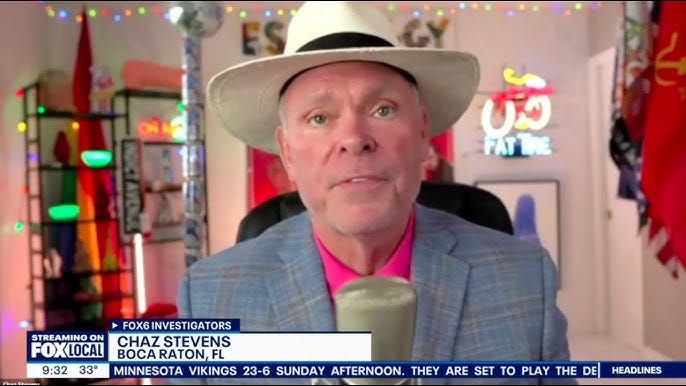
By T. Chaz Stevens
The clinician who got the recruiting email this month, last month, the month before — and hasn’t clicked Apply yet. This is for that version of you. Maybe your panel reimbursements got cut again, or your private-pay caseload thinned out, or you’re staring down a quarter where the math doesn’t quite work. The recruiting copy looks legitimate. The platform has a real website, real testimonials, real licensed clinicians on the roster. There’s a careers page. There’s a pitch deck. Somebody from “Provider Relations” returned your email within four hours.
Not for the clinicians already on the roster. They knew $15 for auto-penning a letter violated a stack of ethical canons and probably state and federal law on top. They made their call. This piece isn’t going to reach them anyway.
You are the audience.
The recruiting pitch
The email arrives looking like every other clinician-recruiting pitch in your inbox. Telehealth platform expanding its provider network. Flexible hours. Set your own schedule. Work from home. No insurance billing. No EHR. No prior auth. We handle the intake, you handle the clinical decision. Compensation: $15 to $50 per completed letter, depending on volume tier. Average provider clears $2,400/month working evenings.
Solo practice without the solo practice overhead. Clinical work without the panels. Income without the grind.
What’s not in the email:
How many minutes you’ll spend per file. What the platform charges the consumer. Whether your state license is appropriate for the consumer’s state of residence. Malpractice coverage. Who owns the clinical record. HIPAA infrastructure. Business Associate Agreement. Indemnification. What happens if a state board or a landlord or a chargeback comes back at you.
None of that is in the email by accident.
The math
The platform charges the consumer $99 to $199 for an “ESA letter.” Some run higher. Some bundle in a “PSA letter” or a “renewal” upsell. Call the average sticker price $129.
The platform pays you $15 per letter. Sometimes $25. Tier up to “preferred provider” status and maybe $50.
The spread is not margin. The spread is the price of risk transfer.
Marketing costs the platform real money. Google Ads on “ESA letter fast” runs $8 to $14 per click, and conversion rates on impulse mental-health buys are not great. Stripe takes 2.9% plus 30¢. Hosting, support, the chatbot, the WordPress theme, the recruiter who sent you the email. All real expenses.
The expense the spread actually pays for is regulatory exposure. Filing complaints. Defending complaints. Refunding chargebacks. Eating disputed transactions. Replacing clinicians who quit after a board investigation lands. Buying lawyers when the state AG sniffs around. Buying more lawyers when a federal agency does.
The platform is not paying you $15 to write a letter. The platform is paying you $15 to absorb the part of the business it doesn’t want on its own balance sheet.
You are the part of the business it doesn’t want on its own balance sheet.
Risk transfer is the business model
Licensing. Your name is on the letter. Your license number is on the letter. When a state board receives a complaint, the complaint names you. Not the platform. You.
Malpractice. The plaintiff’s lawyer sues the practitioner whose signature is on the document. The platform might be a co-defendant. You are the defendant.
HIPAA. Whose NPI is on the breach notification? Yours. The platform’s privacy policy disclaims responsibility for the conduct of “independent healthcare providers.” You are an independent healthcare provider.
HUD complaint. When a landlord rejects the letter and the tenant files an FHA complaint, HUD investigates the letter. The letter has your name on it. HUD asks what evaluation supports the personal-knowledge requirement. You have a Likert score and ninety seconds of dashboard click history.
Chargebacks. When the consumer’s landlord rejects the letter and the consumer files a chargeback, the payment processor investigates. They look at the merchant of record (the platform) and at who provided the service (you). When the platform’s processor wants to deflect, your name is the deflection.
Civil discovery. If the platform gets sued in a consumer-fraud action, the plaintiff’s lawyer subpoenas the clinician records. Those records are you.
The platform’s exposure caps at refunding the customer. Your exposure is your license, your insurance, your name, and your career.
That asymmetry is not a bug. It is the entire reason the platform exists in the form it exists in. If the platform absorbed its own risk, the unit economics fall apart. The model only works if you carry the risk for $15 a letter.
The thing that ends your practice: getting MATCHed
Most clinicians have never heard of it. Most malpractice carriers don’t bring it up either, because it’s outside their coverage entirely.
Visa and Mastercard maintain a list called MATCH — Member Alert to Control High-risk Merchants. Sometimes called the Terminated Merchant File, or TMF. When a payment processor terminates a merchant for fraud, excessive chargebacks, illegal activity, or material misrepresentation, that merchant lands on MATCH. The list is shared among all major card networks and acquiring banks. Once you’re on MATCH, you’re on for five years. No major payment processor will board you. You can’t take card payments. For a private practice in 2026, that’s a death sentence. Try running a therapy practice when patients can’t pay with a card.
You think this is a platform problem, not your problem.
When chargebacks hit the platform, the platform’s processor investigates. They look at the underlying transaction. They find your NPI on the letter. They find your license number on the receipt. They find your name in the platform’s clinician roster. The platform’s processor files an investigative inquiry, and the platform — to save its own merchant account — throws you under the bus. Your name flows downstream.
Now your own merchant account, the Stripe account or Square account you use for your private practice, gets cross-referenced. If your name is associated with chargeback patterns, fraud allegations, or regulatory action, your processor can terminate you. Stripe’s TOS specifically reserves termination rights for “high-risk activity” or “regulatory concerns.” They don’t need a court order. They need a risk score.
Once Stripe terminates and reports to MATCH, you spend the next five years explaining to every potential processor why your EIN is flagged. Most won’t even take the meeting. Square, same. PayPal, same. Helcim, Stax, all of them, same.
Your malpractice carrier might cover the board complaint. Your malpractice carrier cannot un-MATCH you. You can survive a licensing investigation. You cannot run a practice when no one will process a card payment for you.
The job, described accurately
Here’s what they’ll ask you to do, once you’re hired.
The consumer goes to the platform’s website and answers a Likert quiz. You know the format. Strongly disagree, disagree, neutral, agree, strongly agree, ten or fifteen items, scored. The quiz lives inside a WordPress site or a Squarespace template. It is not on a HIPAA-compliant platform. There is no Business Associate Agreement. The consumer’s mental-health disclosures, symptoms, diagnoses they’re claiming, medications they’re listing, flow through whatever cookie tracker, analytics pixel, and third-party form processor the marketing team plugged in last quarter.
The quiz is not the BDI. It’s not the PHQ-9. It is a homemade questionnaire some marketing person wrote, with cutoffs reverse-engineered to approve everyone. If you’re in the biz, you know the difference between the Beck Depression Inventory and a DSM-5 cross-cut. The platform is hoping the consumer doesn’t.
If the consumer’s score crosses the threshold, the system flags the file as “approved-pending-clinician-review.”
That’s where you come in.
You log into a back-end dashboard. You see a queue. Each entry shows the consumer’s name, the questionnaire score, a few free-text answers, maybe a self-selected diagnosis from a dropdown. You click Approve. The system merges the data into a templated letter. PDF generates. Email sends. Stripe captures the next $129.
Total clinician time per file: ninety seconds, maybe two minutes if you read the free-text answers.
The letter that goes out under your name says you “completed a clinical assessment.” It says the consumer “meets the criteria under the Fair Housing Act.” It says they “have a mental health condition as outlined in the DSM-5.” It says the ESA “serves as an essential component in their ability to function.”
Now look at what you actually did.
No synchronous interaction. No video. No phone call. No mental status exam. No risk screening. No suicidality screen. No identity verification. No informed consent worth the name. No SOAP note. No progress note. No clinical reasoning anywhere on disk. No treatment plan because there’s no treatment relationship. No discussion with the consumer about what an ESA letter actually does, what its limits are, or what happens when their landlord challenges it. No discussion about the data they typed into a Squarespace form that probably leaks to Google Analytics. No referral pathway if the questionnaire flagged something serious, because the questionnaire is not designed to flag anything serious.
Every single thing missing from that workflow is a thing you were trained, explicitly, in graduate school, on board exams, in supervision, in your ethics CE every two years, to never skip.
The platform is selling the consumer a clinical assessment. You did not perform a clinical assessment. The math does not work.
You’re not a contractor. You’re inventory.
You think you’re a contractor. You think the relationship is platform-and-professional. You think when something goes wrong, the platform stands with you, or at least beside you. That is not the relationship.
You are inventory. The platform has hundreds of clinicians on the roster. You are a line item. The day a regulator or a plaintiff’s lawyer surfaces your name, you stop existing to them. Your account gets deactivated. The recruiter who sent you that warm email stops returning your messages. The next clinician on the bench takes your shifts. You were never a partner. You were stock-keeping unit, and SKUs get written off.
The proof on the public record:
In October 2025, a federal court in Louisiana dismissed a case captioned Greater Guide, Inc. d/b/a American Service Pets v. SAPS LLC, Prevent ESA Fraud, Inc., and Dominick Latino, III. Civil Action No. 25-428, U.S. District Court, Eastern District of Louisiana, Document 83 on the docket.
ASP is one of the larger ESA letter mills. They sued a competitor under a kitchen-sink theory: Sherman Antitrust Act, Computer Fraud and Abuse Act, civil RICO, plus state-law claims. ASP’s allegation: the competitor used investigators to submit roughly 31 fictional applications to ASP’s site, get ESA letters issued by ASP’s contracted clinicians, and then file regulatory complaints with state licensing boards against those clinicians.
ASP’s own pleading, in its own words: those regulatory complaints “led to various mental health care providers terminating their agreements with Plaintiff.”
The clinicians, ASP’s own contracted providers, quit. They walked off the platform when state licensing boards started looking at them. They didn’t stay and fight. They terminated their own contracts to save their licenses.
ASP went to federal court, not to defend the clinicians, not to make them whole, not even to mention them as injured parties. ASP went to federal court to recover the platform’s losses. Lost ad spend, lost recruiting investment, lost revenue while it rebuilt the network. ASP wanted antitrust damages from the entity that had spooked its inventory.
The court dismissed everything on October 31, 2025. The Noerr-Pennington doctrine immunizes the act of filing regulatory complaints with the government. Even if those complaints have anticompetitive intent. Even if the complainant is a direct business competitor. Even if the goal is to destroy the target company. Filing a complaint is petitioning the government, and you cannot punish that through antitrust law.
The clinicians who lost their licenses or contracts are not parties to that lawsuit. They are not named. They are not seeking damages. They are not mentioned in the relief sought. They are, in the platform’s own pleading, the cause of the platform’s losses, “providers terminating their agreements with Plaintiff,” but they are not the platform’s concern as injured parties. They are the inventory that walked off, and the lawsuit is about who scared it off.
That’s what you would be. SKU on a roster, written off when the inquiry lands.
The thing you didn’t know you were selling: consumer fraud
Every state has a consumer-protection statute. Florida has FDUTPA. California has the UCL. New York has GBL § 349. Texas has the DTPA. They are built on the same architecture: deceptive acts in trade or commerce, with private rights of action, and in many states, treble damages, attorney fees, and class action exposure.
The fraud is not subtle.
The platform sells the consumer “a clinical assessment.” You did not perform a clinical assessment. You reviewed a Likert score for ninety seconds.
The platform sells “a letter that meets HUD’s reliability requirements.” HUD’s reliability standard requires personal knowledge of the patient. You have no personal knowledge of this patient. You have a questionnaire score.
The platform sells “ESA letters from licensed clinicians authorized to evaluate patients in your state.” If you are licensed in California and the consumer is in Florida, you are not authorized to evaluate that patient in Florida absent telehealth registration with the Florida Department of Health.
The platform sells the consumer something the platform does not actually deliver. That is a deceptive trade practice. The clinician who signs the letter, even if the clinician is not the merchant of record, is a participant in the transaction. Most state consumer-fraud statutes reach individuals who participate in, authorize, or benefit from the deceptive practice. You are not a downstream contractor. You are the product. Your signature is what’s being sold.
When the regulators or the plaintiff’s lawyers come, they come for the product first.
The thing you didn’t know you were doing: practicing law without a license
Every ESA letter you would sign makes legal determinations.
“This patient meets the criteria under the Fair Housing Act.” Conclusion of law.
“This patient is entitled to a reasonable accommodation under federal law.” Conclusion of law.
“Pursuant to 42 U.S.C. § 3604(f), the housing provider is required to make a reasonable accommodation.” Conclusion of law.
You did not go to law school. You are not licensed to practice law in any state. The platform’s template puts those conclusions in your mouth, under your signature, with your license number underneath, sent to a landlord who will rely on them in deciding whether to grant or deny a housing accommodation.
That is the unauthorized practice of law. Sperry v. Florida State Bar (1963) is the classic citation. Non-lawyers in professional capacities applying federal law to a client’s specific facts, even with state authorization to do adjacent work, were still committing UPL. Every state bar has a UPL committee. Florida’s has been active. Other states’ are catching up.
A secondary issue: when the platform’s intake bot answers a customer’s question about “what does the FHA require my landlord to do,” that is also the unauthorized practice of law. The platform commits UPL through its chatbot and customer-service flow. Your signature on the letter is the cover that makes the whole thing look like a clinical service rather than what it actually is, which is unlicensed legal advice dressed up as healthcare.
You think you’re issuing a clinical opinion. You’re issuing a legal opinion you’re not licensed to give. The platform knows this. That’s why your name is on the letter and not theirs.
The asymmetry
Their lawyers versus your lawyer.
The platform has corporate counsel. They have outside counsel on retainer. They have terms-of-service indemnification clauses written by people who do this for a living. They have insurance. They have a corporate veil. They have capital. When the heat comes, they have a thousand pages of paperwork and three lawyers in a conference room.
You have a single-practitioner LLC. You have a malpractice policy that may or may not cover this work. Go check. You have whatever savings are sitting in your business account. You have a mortgage. When the heat comes, you have your malpractice carrier’s panel attorney, who handles four other cases on the same Tuesday, and a phone that won’t stop ringing.
When that asymmetry collides, and it does collide, regularly, in this industry, guess which way the system bends.
The closer
Fifteen dollars per letter. Ninety seconds of clinical review.
Your license. Your malpractice carrier. Your NPI on the breach notification. Your name on the board complaint. Your account on the MATCH list. Your career.
If you’ve read this far and you’re still considering the job, that’s your call. Make it with eyes open.
Read the indemnification clause in the platform’s contract. Read it twice. Highlight the part about “independent contractor” and the part about “you agree to defend, indemnify, and hold us harmless.” Notice which direction those clauses point.
Call your malpractice carrier and ask, in writing, whether ESA letter work for an online platform is covered. If it’s not in writing, it doesn’t exist.
Ask the platform for a Business Associate Agreement. If they don’t have one, you have your answer.
Ask whether you’ll be issued a 1099 or a W-2. Ask what the platform’s chargeback policy is. Ask what happens to your file if a board complaint comes in. Ask who pays the lawyer.
If the answers are vague, or if the recruiter gets impatient, that tells you what you need to know.
Fifteen dollars is not enough to find out the hard way.
One More Thing
I’ve been doing this work for thirty years. Pro se lawsuits. Records requests. Bible challenges in 63 school districts. An FDUTPA injunction against an ESA letter mill, obtained without a lawyer. Statutes rewritten because I filed the wrong kind of paperwork the right way.
None of it has ever had an institution behind it.
No legal defense fund. No nonprofit board. No foundation grant. I fund the work myself. Filing fees, service, transcripts, records costs—it all lands on me. When a records custodian quotes $1,326.08 to produce documents the statute requires them to produce, that’s a bill I either pay or the work stops.
I’ve filed against Donald Trump, the Broward County School Board, State Representative Chip LaMarca, and ESA letter mills as indigent. Court-recognized. Sworn financials. Judges reviewed and approved every time.
This is the work. It produces results.
HB 1467 was rewritten, with the administration of Ron DeSantis naming me in the revision. The ESA injunction is a replicable enforcement model. The Wisconsin State Capitol approved a permit in 48 hours for an installation that normally takes ten business days to process.
The work works.
The math doesn’t.
I’m looking for paid work in three areas—defined by outcomes, not categories.
Accountability & Records
I identify exposure points in agencies and organizations using public records, then force resolution—through compliance pressure, media, or litigation.
Media & Narrative Engineering
I design stories that land. Not pitches that get ignored—events and documentation that reporters have to cover.
Technology & Infrastructure (Ecomm, GEO/SEO, Systems)
I’ve spent thirty years building systems that move money and control visibility.
Helped launch Disney.com and Blockbuster.com
Sold 60,000 vehicles through eBay—full pipeline, not theory
Worked inside NASA, IBM, and Microsoft
What I do now:
Build e-commerce systems that convert, not just attract traffic
Implement GEO/SEO so AI and search engines represent you accurately—and defensibly
Diagnose and fix structural issues in digital infrastructure that suppress performance
If your organization has traffic but no conversion, visibility but no control, or systems that “work” but don’t scale—I fix that.
If you run a nonprofit, newsroom, law firm, municipality, university, or company that needs any of this, contact me.
chazstevens@gmail.com
954-901-0971
If you don’t, forward this. One introduction changes the month.
If neither applies, the Consent Can funds the work. Women In Distress gets a cut.
I’ve spent thirty years making it expensive for corrupt people to stay corrupt.
I intend to keep doing that—and get paid for it.
T. Chaz Stevens, MSc, is an investigative journalist and public-interest litigant. He previously obtained a permanent injunction in Florida circuit court against an ESA letter-mill operator under FDUTPA (Stevens v. Tinner, Broward County Case No. CACE25010712 — concluded). He writes about consumer protection, regulatory enforcement, and other things polite society considers boring until it’s too late.
This piece was drafted with AI assistance and is offered as journalism and public-interest commentary. It is not legal advice. It does not opine on the conduct of any non-adjudicated party. If you are a clinician with questions about whether a specific platform arrangement creates exposure for you, retain an attorney licensed in your state. Don’t take legal advice from a Substack post — including this one.